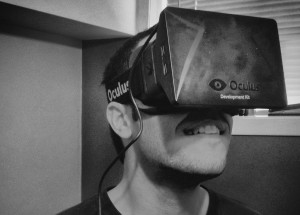
My only other experience with a virtual reality headset was back when Nintendo released the VirtualBoy. I distinctly remember trying it the Price Club near my house. With its entirely red display and pixelated as hell graphics, it’s no wonder the device failed. Fast forward many, many years later and here we are in the present day with the Oculus Rift. I’ll list out the impressions by category to make things easier.
Visuals
At first, I wasn’t incredibly impressed with the visuals. My friend had the A cups inserted, so that made my vision very blurry and narrow. I swapped out A for C and things drastically improved. I was finally able to read text and unfortunately, individual pixels. We loaded up some of the tech demos and while they were cool, they lacked polish and refinement; though, the toilet simulator made me laugh harder than I should have. After taking a few breaks to help ease the dizziness, we tried minecraft and half-life 2. Minecraft was my favourite demo of the bunch because I feel it best implemented the new features of the Rift. 3D depth of fiend was quite apparent when you ran up a mountain and looked down. I felt as if I were atop a real mountain, along with all the vertigo that goes along with it. The only thing missing was the sound of birds, my heartbeat and a cool mountain breeze. Half-Life 2 needed a third party tool to transform the game to the Rift and it looked good but not great. I’ll end with saying I mainly stood
Feeling
I’ll start by saying I do suffer from slight motion sickness if I’m in a car. I can’t read or look down while someone else drives or I’ll get an instant and long lasting headache in addition to mild nausea. The unit felt a bit heavy at first but I got used to it quite fast. It felt great after that, though the nose piece did poke my forehead a couple times, no biggie. I felt a bit strange when loading up a few games, and moving was out of the question as it instantly brought on some nausea. I eventually got used to it, and paired with an xbox 360 controller, began my journey up a mountain. I felt some slight vertigo at the top as I peered down, but the amazing sensation and immersion felt better and I forgot about everything else I was feeling. The immersion with this unit is incredible. I didn’t use a set of headphones, but I can only imagine how much better that would be. I’ll eventually move around with the joystick, but for my first try I wanted to ease into the experience, and not go nuts like some others have. Some certainly pay the price with motion sickness afterwards.

Final Thoughts
I think the Rift is a game changer ( literally, hurrr ). The immersion I felt was instant, and very gratifying. I can see puzzle and horror games taking off with the Rift, with Architecture students using the unit to its fullest. Once the production unit hits with a higher res screen and better refresh rate, I can see a lot of the dizzy spells going away.